

/migrated from Canine Hacking blog, 11.01.2020/
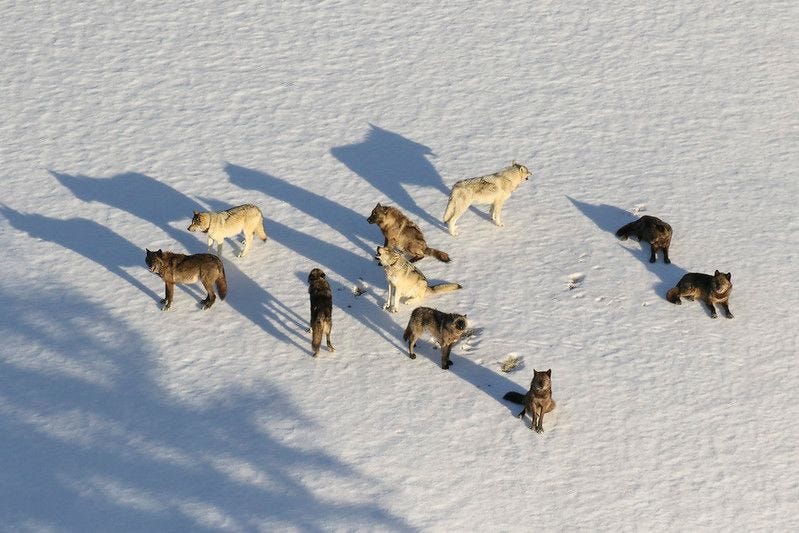
During the summer of 2019, the pack of 11 adults attended a den of pups near a popular hiking trail in the northeastern section of the park. Wanting to keep visitors and wolves apart, the park closed the den and surrounding area to the public. When the pups approached the trail and were in proximity to hikers, most people quickly moved away. However, some people violated the required 100-yard distance from wolves and approached the pups when they were on or near the trail to take a photo. Other people illegally entered the closed area to get near the wolves. Having grown accustomed to hikers, the pups then came close to visitors along a road.— by NPS, 18.12.2019[1]
Those reported details strongly suggest a human recurring appearance in the middle of those pups’ developmental management’s crucial stage, including a very short part of being socialisation-habituation extremely predisposed.
Back then, I found two interesting news during few days of browsing North American websites. One of them encouraged to observe wild Yellowstone wolf packs’ members as easy to notice on the fresh snow during consumption of hunted animal carcasses, in poetic company of scavenging birds (as competitive mesopredatory carnivores looking for their chance).[2] Whereas another one informed about a pair of Yellowstone National Park’s wolf pups (confirmed as Junction Butte pack leading pair’s offspring) fatally hit by a vehicle when they hung around the road - their den was localized nearby - likely they’re used to human activity (sounds, smell, vision example).[3]
In the NPS Yellowstone status, it stands clear:[4]
Never feed wildlife. Animals that become dependent on human food may become aggressive toward people and have to be killed. Keep all food, garbage, or other smelly items packed away when not in use.
also
Never approach animals. The animals in Yellowstone are wild and unpredictable, no matter how calm they appear to be. The safest (and often best) view of wildlife is from inside a car. Always stay at least 100 yards (91 m) away from bears and wolves, and at least 25 yards (23 m) away from all other animals, including bison and elk.
According to Yellowstone Park press releases, the “stay 100 yards away” rule was being repeatedly violated.
It made me think about Yellowstone wolves in particular. If they have shortened their flight zone - by adaptation to common visitors, scientists and wildlife observers presence nearby (entire tourism in general) - they’d treat the offered environment like their ecological niche. Trimmed in such way flight zone points to a habituation as an adaptation to human presence, what - accidentally or in specific conditions - allows to survive, temporarily or permanently (here comes a taming process).
Wildlife is a set of multiplicitous ecosystems of animals (fauna) and plants (flora) living there without a human influence or just not affected by human activity at all. Wild animals are not controlled by their natural environment, not tamed nor domesticated. Every species’ existence proceeds keeping with its nature instinctively.
Canis lupus species is an exemplary predator in its natural habitat, living in family packs each one - hunts (gaining food), stays safe (active / passive protection) and reproduces (offspring of the leading parent pair). To sum up - it can survive, when the one of conditions to be fulfilled is avoiding a human.
If an animal is able to not be scared of human presence in a relatively close distance, it means that its taming is possible. A tamed animal is a wild animal which previously adapted to humans in its natural way (socialization/habituation process).
What’s positive
The animal is easy to observe, still living in the relatively natural habitat.
Scientists, researchers and/or aware wolf lovers benefit for science, study and/or wolf advocacy (more knowledge, collected data, educated ranchers, farmers, citizens, social media sympathy).
And what’s negative
The observer effect (Hawthorne effect) associates changes caused by wild animal’s awareness of being observed (optionally modified behavior), in consequence adaptation to the situation (feeling safe).
Unstable / unpredictable behavior deviates from the ethogram,[5] e.g. scavenging on garbage (resources reachable within ecological niche) instead of hunting destined preyed animals or approaching too close to potentially dangerous objects (limited avoidance).
Wild wolves’ situation within the European area is different from their distant fellows. American ones (Arctic, Timber and so on) are generally observed - they live mostly in vast treeless territories, migrating between hunters trophy zones, where is allowed to shoot them almost in every state. Wolves in Europe (Eurasian type) are difficult to encounter in wildlife - they migrate across the continent protected by EU in the membership countries, hunting their destined prey in deep forests.
Polish Association for Nature “WOLF” issued official rules dedicated to local residents, forest workers (forest rangers, foresters, lumberjacks), professionals (scientists, researchers, wolf watchers, wildlife photographers), common tourists and mushroom pickers - precisely describing point by point how to act properly, universally. It emphasizes: to not feed wild animals intentionally,[5] to keep garbage secured, not leave food in camp places (even if they look cleaned up regularly), to take lunch leftovers away from forest workplaces and not set up temporary trashcans. The goal is to prevent making of the one of fundamental survival conditions any reason for ecological niche being adapted - a food resource reachability without a risk.
If you are a wildlife photographer or a hunter, never provide meat to bait animals near hideouts, observation towers or balconies. Wolves, thanks to their sensitive scent sense, can start to perceive humans as food management.
That rule concerns especially wolf youngsters (socialization/habituation aspect).
On the other hand, Polish road reports inform about approximately 50 wolves - among them some pups - confirmed fatally hit by car in 2019, in sections overlapping forest or field-forest areas.[6] Those European accidents are strictly related to unlimited animal migrations - by wildlife corridors (far from human activity, hazard avoidance) or just across random roads if such corridor is not available (danger ignored by frightened or determined animals).
Ecotourism and proper education are essential here.
Correctly interpreted ecotourism means the knowledge in practice - animal footprints to identify, ecosystem study / data collecting, trekking, hiking trips. It includes the ethical photography and wild animals observation from rigorous distance and in complete silence. If it progresses, ecotourism correlates to profits (cabins rental, guides payment, local souvenirs trade).
Correctly educated person balances teaching and learning - human conflict decreases, wolf awareness increases. If it progresses, education is able to be passed in theory down to others (conversations, seminars), performed (social media, presentations, workshops) and as a result practiced by ecotourists.
Both of them should collaborate with each other.
[1] NPS official release
[2] NBC [Wyoming US, 16th Dec.2019]
[3] OIL CITY NEWS [Montana US, 18th Dec.2019]
[4] Scientific description of a structure typical for selected species behavioral model, including instinctive reactions, rigid patterns and elastic habits, complete them as an established standard.
[5] Feeders functionality should be reconsidered paying attention to terms of their real necessity - scientifically and expertly justified.
[6] Association for Nature “WOLF” [Poland, 31th Dec.2019]
Other sources:
Yellowstone National Park regulations about wolves