

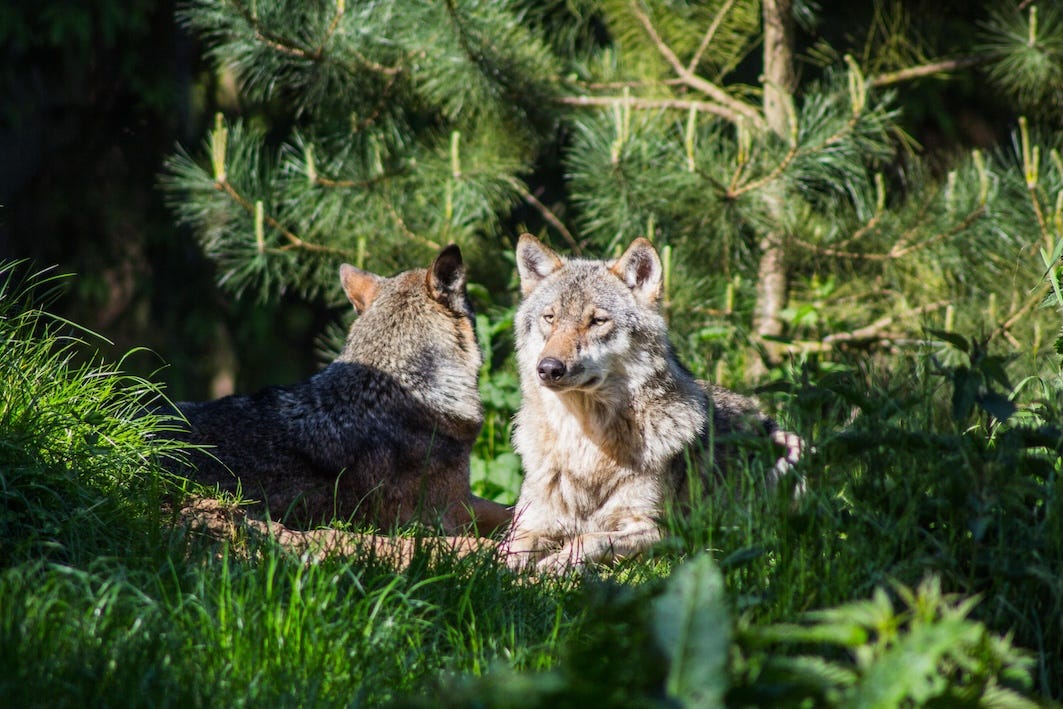
Historically, neither moose nor wolves inhabited Isle Royale territory.
Primarily, its flora had been mostly the taiga - boreal forest consisting of pine, spruce and larch - natural environment for boreal woodland caribou and Canada lynx, then coyotes (afterwards, suppressed by the wolves). Ultimately, prey←→predatory related residents had been hunted down or just superseded by human activity. According to scientific investigation, moose introduction was initiated by hunters, for private preserve, in 1900s. Another theory stands that moose simply swum across the lake. A pair of wolves was supposed to cross the ice from the mainland, in the winter season in 1940s.
Limited by the isolated area, relationship between Royal Isle wolves (single predatory species) and moose (single prey species) turned out to be unique for ecologists, scientifically studied (over 5 decades[1]) as a pure environment based on wolf-ungulate coexistence functioning without omnivore bear’s competitive presence for example. Scientists still scavenge the forest for remains of moose carcasses (in summer) and/or make surveys from the sky (in winter) researching that habitat up to date. However, its simplicity means that every single factor is able to impact the local population of such selected species or to upset the whole balanced ecosystem.
inbreed hazard
Single pair which pioneered the Isle Royale wolf population, made it severely inbred by years (DNA seems to be traced back to one ancestor), leading to inbreeding depression and in consequence to health problems (including genetic diseases), constantly decimating offspring state by generations.
In 1997, a virile wolf from outside (Canada territory) migrated cross the ice to the island, signified as the No.93 and called “Old Gray Guy” - his fur became unusually pale as he aged.
We don’t know of any other instance - except when they first came - of wolves crossing the ice — John A. Vucetich said, as co-author of the long-term Isle royale wolves study[2] — The entire population is descended from a single female.
In 2009, 56% of Isle Royale wolves seemed to be descended from No.93 as a single male.
diseases (caused by inbreed or not) / natural disasters / random accidents
In 1982, due to canine parvovirus brought by a companion dog being taken by tourists for a fishing trip offered by Isle Royale NP (in summer), none of wolf offspring survived the winter season; after that 36 of 50 individuals were dead within two years.
climate changes (including natural disasters or not) / global warming
Warmer winters - with less (or no) freezing cold, snow, frost - imply fewer ice bridges, making the island even more remote, new wolf migration impossible (in general, wolves are not natural born swimmers), indirectly they affect the genetic diversity there.
Depending on on-going observations, there was only one, non-breeding pair of wolves on Isle Royale - most likely father and daughter which was also his sister (coming from his mating with his own mother). Both of them were not able to proceed any regular successful hunt for a large ungulate without help of the rest of skilled pack members, whereas the moose population exploded up to the extreme number of 2500 (from 500 at the beginning). Regarding every point mentioned above, in the sake of prey-predator balance restoration, Isle Royale National Park service decided about wolf reintroduction to the island, by release of 20-30 individuals in 3-5 years, starting from fall 2018. The only similar experimental case took place in Yellowstone National Park.
inbreed hazard prevention
We hope to capture [wolves] from as many wide-ranging geographical areas as possible to maximize genetic variability of the population that we end up putting into the park — Mark Romanski said, Isle Royale NP natural resources chief.
Captured animals (keeping their packs possibly intact) - coming from variety of neighbouring regions like Minnesota, Michigan, Ontario - were transported by air or by boat to the island, where they were released in different places to prevent potential territorial conflicts. The complete procedure plan involved the process running slowly over time instead of capturing all expected wolves at once.
diseases prevention
Every captured animal was vaccinated and tested for diseases such as heartworm and parvo virus.
We will also be employing radio collars — Mark Romanski said, pointing on technology aspect not such easily accessible when the Yellowstone project started in 1995 along with its cascade model conception research — We will use a mix of VHF and GPS collars. This will allow us to not only collect data not only on a fine scale, but also over a number of years.
climate changes (un)avoidance
Global warming is unpredictable same as random accidental event or singular natural disaster itself. The mainland←→island rotation condition (indirectly genetic diversity) is strictly associated with transmigration’s probability - ice bridges chance (in winter), despite warmer, shorter winters. According to data, those bridges have been formed between Isle Royale and Minnesota open area three times for four last years and wolves crossed twice there and back.
Isle Royale National Park (established in 1940) is placed in the Isle Royale, located in the middle of Lake Superior (USA, Michigan). To be strict, Lake Superior [ᑭᑦᒉᐁ-ᑲᒣᐁ, kitchi-gummi, “great sea” in Ojibwe] is shared by United States borders and Canadian province of Ontario. Isle Royale is the largest of 400 Lake Superior islands (72km long, 14km wide, 535.43 km2), which indigenous Ojibwe people considered the island to be their territory until the Isle Royale Agreement in 1844.
Isle Royale NP made it open for tourists, except the winter season when it is entirely closed (accessible only by plane, boat or seasonal seaplane). Potential visitors can explore secluded island which offers tent camp-sites and camper cabins inland (accessible only by foot) or shoreline (accessible only by boat/kayak/canoe). Adventurers can try day hiking (Rock Harbor, Windigo Ranger Station), a guided trip or just go fishing/diving.
Officially, dogs are not allowed in concern about wildlife species living on that limited area (service dogs allowed after permission). Other animals living permanently on the island are beavers, red squirrels and red foxes (some of them used to human contact because of food scraps left by unwary campers), scavenging birds (crows, ravens) and fish.
One issue remains to be considered: Would closing the island completely - or almost completely - for tourists, at least temporarily, help protect that island’s wildlife and preserve its closed predator←→prey ecosystem?
references:
NPS Isle Royale wolf reintroduction project decision (Jun.7th, 2018)
A Case Study on Wilderness Management in a Changing World (2012); by A. Vucetich, Rolf O. Peterson, Michael P. Nelson
Wolves & Moose of Isle Royale
[1] Wolf-Moose Populations fluctuation - Isle Royale project overview
[2] Genomic sweep and potential genetic rescue during limiting environmental conditions in an isolated wolf population (2011); study by John A. Vucetich, Rolf O. Peterson, Leah M. Vucetich, Jennifer R. Adams, Philip W. Hedrick